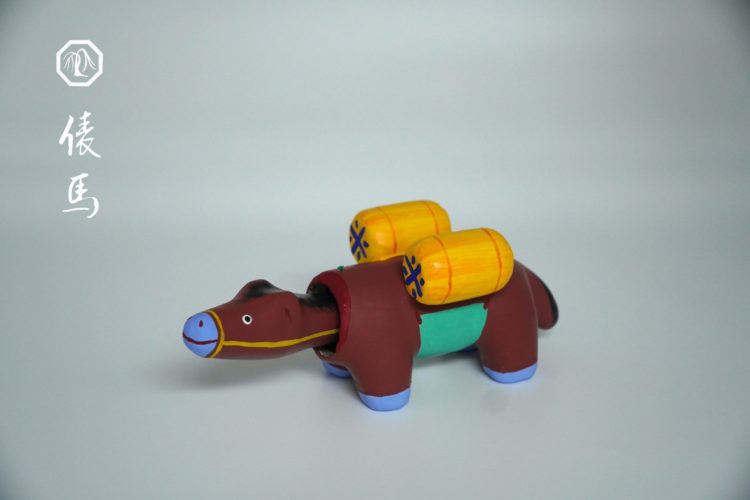
Tawara Uma (Rice Bales Horse)_YANAGIYA REPRODUCT
Tawara Horse (Rice Bales Horse)
Materials: Inshu Washi (Kozo paper)
With cooperation from: Daiinsyu Japanese Washi (Aoya-cho, Tottori City, Tottori Prefecture)
Gofun (white shell pigment), mineral pigments, animal glue
Dimensions: W 20.5 cm × D 9.5 cm × H 7.5 cm
Weight: 45 g
Horse
In Japan, horses have long been an essential source of labor in agriculture and are regarded as symbols of speed, advancement, and success.
There is also a wordplay in Japanese: “uma” (horse) sounds like “things going well” (umaku iku), making the horse an auspicious motif associated with good fortune.
Tawara (Rice Bale)
Rice symbolizes life and wealth in Japan. A rice bale represents abundant harvests, financial prosperity, thriving business, and the flourishing of the household.
Yanagiya was a workshop in Tottori City, Tottori Prefecture, that produced local folk toys for 86 years, from 1928 to 2014.
The workshop’s name derives from the Japanese proverb, “Yanagi ni yuki ore nashi” — “A willow does not break under the weight of snow.”
The founder, Tatsunosuke Tanaka, created original toys inspired by the history and legends of the Inaba region, while also dedicating himself to restoring toys that had fallen out of production. Together with his wife Toshiko, he continued research and craftsmanship. Their spirit of work, true to the workshop’s name, was passed down to their daughter and her husband, resulting in the creation of more than fifty different kinds of toys, including papier-mâché masks, clay bells, and wooden dolls.
Launched in 2020, “YANAGIYA REPRODUCT” is a project in which new makers learn the traditional techniques from second-generation successors Kinji and Miyako Tanaka and carry forward the craft of Yanagiya’s toy production.
For more details:
https://note.com/cocorostore/n/n460cdc2c0afb